A First Group Debrief After a Shared Project
A first group debrief turns a finished project into a clear account, a useful lesson, and one specific adjustment the group can carry into its next task.
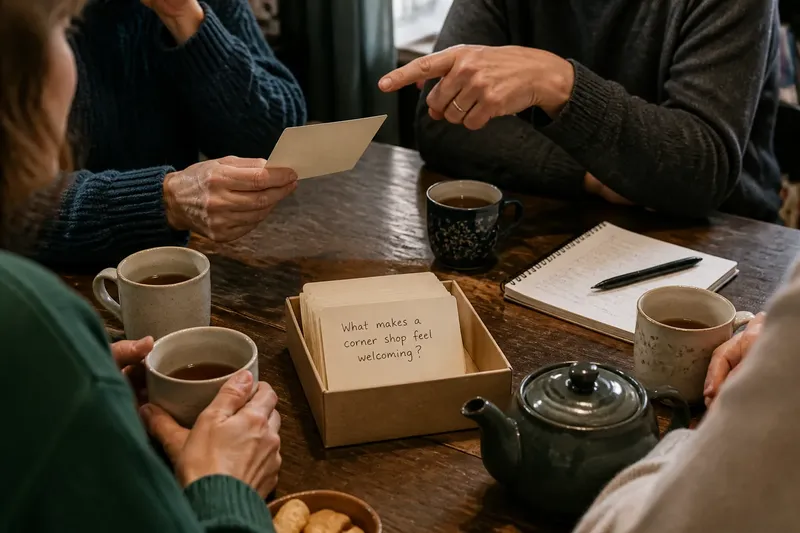
The shared slide deck is sent, the chairs are pushed back, and someone asks whether the group should talk about what happened. A first group debrief can turn that loose question into a useful account of how people made decisions together, especially when the group’s different interpretations point to a process nobody had noticed.
What should this debrief help the group understand?
Choose the purpose before choosing the prompts. A routine task may need a quick check on what to keep and what to adjust. A project with changing roles or conflicting expectations needs time to examine how the group interpreted the work and who had authority to decide.
Set a narrow question for the meeting, such as: “How did we decide what counted as finished?” That keeps the discussion about the group’s shared idea of the work, rather than becoming a general appraisal of everyone involved. Tell participants whether the aim is learning, planning, or both, and be clear about what the conversation cannot decide.
- If the work had a clear outcome but an unclear decision process, examine who made which decisions and what information they used; then choose one decision rule to clarify next time.
- If participants disagree about what the group was trying to make, compare the descriptions they used; then write a shared working definition before the next task.
- If a sensitive conflict is still active, do not use a casual debrief to settle it; pause the group review and seek an appropriate private or qualified channel.
- If the group will resume work soon, focus on one change that can be tried in the next task; leave broader questions on the record for a later conversation.
How can the group examine a shared idea?
Look at how the group’s idea took shape, not just at the finished product. A shared concept can sound settled while people attach different meanings to the same words. “Make it accessible,” for example, may refer to readable text for one person and a simpler sign-up process for another.
Use three passes. First, describe what the group proposed and what changed. Next, identify the assumptions and interpretations people brought to the idea. Finally, decide what the group should make explicit the next time it works together.
- Reconstruct the idea. List the initial proposal, the decisions that altered it, and the points where the group chose between options. Keep each item close to what people said or did.
- Compare interpretations. Ask what each person understood the proposal to mean and what they believed it would achieve. Record distinct meanings without forcing them into a single account.
- Choose a clarifying move. Decide what would make the next shared idea easier to discuss, such as defining a term, naming who can approve a change, or asking whose needs have not yet been considered.
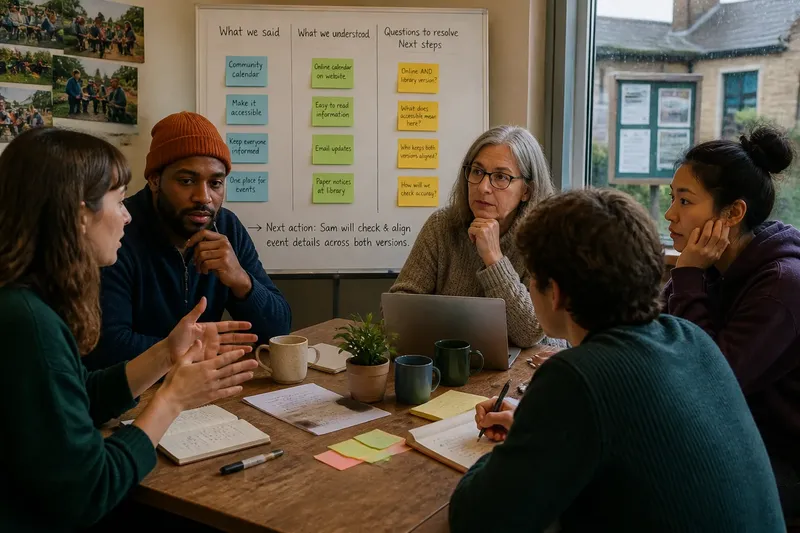
A whiteboard or shared document can help. Put the group’s original wording in one column, the interpretations people describe in another, and questions to resolve in a third. The tool is not the point; the useful distinction is between what was said, what people understood, and what they want to do with that difference.
What if people understood the proposal differently?
Ask each person to describe what they thought the idea meant and which part of the conversation shaped that understanding. Differences may reveal that the group used a broad term without agreeing on its practical meaning, or that one person treated a suggestion as a decision while another heard it as an invitation to keep discussing.
Imagine a fictional volunteer group planning a neighborhood noticeboard. At the first meeting, one person proposes a “community calendar,” another understands that as an online page, and a third imagines paper notices at the library. The group writes those interpretations beside the original phrase, decides that it wants both online and library versions, and assigns one person to check that the same event details appear in each. The result to look for at the next planning meeting is a clear definition of the calendar and a named owner for keeping the two versions aligned.
Messages or draft versions can help clarify when an idea changed, but they cannot determine what a phrase meant to someone. If the record does not settle the sequence, say what remains uncertain. It is more useful to identify an unresolved question than to invent a tidy origin story for the group’s idea.
Which questions help a group discuss shared ideas?
What did we mean by the original proposal?
Ask, “What did you picture when we first used that phrase?” Invite people to name a concrete feature or outcome, so the group can see where meanings match and where they differ.
Whose interpretation shaped the final decision?
Ask, “Which concerns changed the proposal, and which did we leave out?” This helps the group notice whether it considered different needs without treating every difference as a contest to win.
What should we clarify before agreeing next time?
Ask, “Which word, choice, or responsibility needs a clearer definition?” The answer can become a specific prompt for the next planning conversation rather than a general instruction to communicate better.
How can the group turn its discussion into a next move?
Write one action that changes how the group develops or interprets ideas. Keep it observable, assign it to someone, and name the next occasion when the group can check whether it happened.
- If the group used a broad term without a common meaning, write a one-sentence definition before approving the next proposal; if the term still has competing meanings, list them and decide which one applies to the task.
- If suggestions were treated as decisions too early, mark proposals as “open” until the group names an approver; if no one has authority to approve, agree who will make that decision.
- If one perspective was missing from the discussion, identify whose experience or knowledge is needed; if that person cannot join, record the limitation and decide whether the group can proceed responsibly.
- If a change to the shared idea was hard to track, record the reason beside each proposed change; if the reason is unclear, ask the proposer to explain it before accepting the revision.
- If the group cannot yet choose a change, record the unresolved question and what information would help answer it; if that information is unavailable, decide whether to pause or proceed with the uncertainty stated.
- If the action has no clear owner, ask who will carry it forward; if nobody can take responsibility, remove it from the action list or assign time to revisit it.
Say the proposed action aloud before closing. For instance, “Before the next planning meeting, Maya will add a one-sentence definition beside each new proposal” gives the group an action it can recognize. “Be clearer” gives it a mood to aspire to.
When is the debrief complete?
Stop when the group can describe how its idea developed, identify at least one meaningful difference in interpretation, and name a next move—or state what prevents a decision. A debrief does not need to produce unanimous agreement. It needs to leave the group less vague about what it meant and what it will do next.
Share a concise record with participants and invite corrections to factual details. Keep the unresolved questions, chosen action, owner, and next occasion; leave out a transcript of every comment. What is not worth the effort is polishing a single lesson until everyone appears to have held the same view all along.
A first group debrief is useful when it helps people notice how a shared idea acquired its meaning. Keep the proposal, the interpretations, and the next action distinct, and the group can carry forward a clearer basis for its next decision.