From Parlour Game to Conversation Prompt
Parlour game questions give a gathering a shared subject without requiring matching stories, helping guests connect different observations and carry an idea forward.
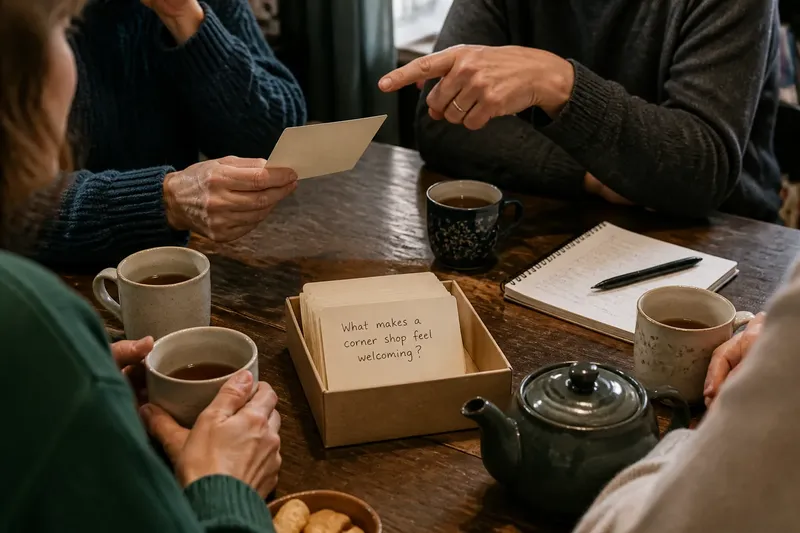
A host sets a box of parlour game questions beside the tea. One guest reads a card aloud; another points out that the answer depends on which side of the neighborhood you live on. Soon the group is comparing the different ways they use the same street. The card has done its job by giving them something specific to think about together.
Parlour game questions can serve more than a round of answers. Chosen carefully, they help people notice where their perspectives meet and differ, then turn those differences into a topic the group can carry forward. That takes less rule-making than a game, but more attention to what the question invites.
How can parlour game questions create a shared subject?
A gathering does not automatically have a common point of reference. Guests may know one another unevenly or see a familiar place in different ways. A prompt makes one subject visible to everyone, so the conversation can begin with the question rather than a demand to tell a polished personal story.
The useful part is not that every person gives an answer. One guest may offer a quick observation, another may ask a follow-up, and someone else may disagree with the premise. Those responses can reveal the subject’s different edges. The group has more to work with than a row of separate performances.
For instance, “What makes a corner shop feel welcoming?” can lead one person to mention a clear window, another to point to the greeting at the counter, and a third to say that quiet browsing matters more. The answers differ, but they stay connected to a question the group can examine together.
What makes a question worth keeping?
A useful prompt is specific enough to give people a foothold and open enough to allow different kinds of answers. Questions about ordinary objects, places, or routines often work because guests can respond from observation, preference, memory, or imagination. Nobody has to supply the most intimate story in the room.
Before putting a card into the stack, use these checks. Each one pairs an observation with a decision, so the host can edit the prompt rather than hope it behaves.
- Answer range: If the question permits a short observation as well as a story, keep it; if it requires a long anecdote, rewrite it to accept a brief answer.
- Privacy: If a guest can answer without exposing family, health, work, or other sensitive details, keep it; if disclosure is built in, replace it with a question about a place, object, or preference.
- Shared footing: If guests with different backgrounds can understand the subject without specialist knowledge, keep it; if it depends on a narrow reference, use a familiar everyday topic instead.
- Room for difference: If reasonable answers could disagree, keep it; if the card points toward one expected response, rephrase it to invite more than one interpretation.
- Useful follow-up: If another guest can ask a natural question about the answer, keep it; if the prompt produces isolated facts, add a specific point of comparison.
- Easy refusal: If someone can pass or answer lightly without explaining why, keep the format; if the rules require a turn from everyone, remove that requirement.
It is not worth the effort to make every card witty or to sort a small stack into elaborate categories. A plain question that helps the group compare what it notices will do more than a clever one that leaves guests guessing at the intended answer.
How can different answers become a group idea?
Difference becomes useful when the group has a way to hold it in view. The host can listen for a shared subject beneath unlike answers, then name that subject without pretending the group has reached agreement. “We have three different ideas of what makes this place welcoming” is a more accurate bridge than “So we all agree.”
From there, the host can ask a modest follow-up: What do those differences suggest the group should consider? That question moves attention from individual answers toward a shared idea, while leaving room for the group to decide whether any action follows. Sometimes the result is a useful distinction, not a plan.
Say a neighborhood association is meeting in a library room, and the host has three handwritten prompts: “What helps you feel welcome in a public place?”, “What do you notice when a room is easy to use?”, and “What small change would make this room clearer to a new visitor?” The host reads the first. One guest mentions signs near the entrance; another says a greeting matters; a third prefers being able to enter without having to speak to anyone. The host notes the difference, then asks what it suggests about the room. Guests identify two separate needs: clear directions and freedom to browse quietly. They choose to carry both points into their discussion of a proposed welcome area. The resulting idea is not a vote for one style of welcome; it is a clearer description of what the space may need to accommodate.
How should a host guide the conversation?
Read the prompt aloud, leave a pause, and let someone begin. If the group is unsure, the host can offer a brief answer that demonstrates the expected scale without claiming to set the right response. If the first answer opens a useful thread, follow it. If it does not, the card need not be rescued with a series of increasingly desperate questions.
Passing should stay simple. A guest can listen, answer in a less personal way, or decline without giving a reason. The host should not circle back to collect a response. That keeps participation voluntary while allowing the group to share a subject.
When several people speak at once, invite them to take turns so their points can be heard. When one person dominates, ask what someone else noticed or offer the group a quiet moment before moving on. The aim is not equal airtime by arithmetic; it is enough room for perspectives to affect the conversation.
What do hosts ask about parlour game questions?
Are parlour game questions suitable for a mixed-age gathering?
They can be, if the prompts draw on familiar experiences rather than narrow cultural references or specialist knowledge. Choose questions that allow a response through observation or preference, so guests need not share the same memories to take part.
Should everyone answer the same conversation prompt?
No. The prompt gives the group a common subject, not a requirement that each person speak. Guests can respond, listen, ask a question, or pass without explaining their choice.
What should a host do if a prompt leads to silence?
Allow a pause, then decide whether to offer a brief response or move to another card. If the question seems too personal or unclear, set it aside rather than asking the room to justify its silence.
Can printed prompts lead to a shared idea without forcing agreement?
Yes. Name the points of connection and the differences accurately, then ask what the group wants to carry forward. A shared idea can preserve disagreement instead of tidying it away.
What can the group carry beyond the card?
A useful result might be a distinction the group had not noticed, a question worth returning to, or a small proposal that follows from the conversation. It need not be a decision. The card has helped if people now have a clearer subject to continue discussing.
Parlour game questions work as conversation prompts when they make comparison easier without dictating what people should share or conclude. For a gathering, choose one grounded subject, listen for both overlap and difference, and let the group decide what deserves to travel beyond the card.