The Question That Changes the Room
A better question makes its assumptions visible and gives people room to answer the real issue, so a group can turn scattered views into a useful next move.

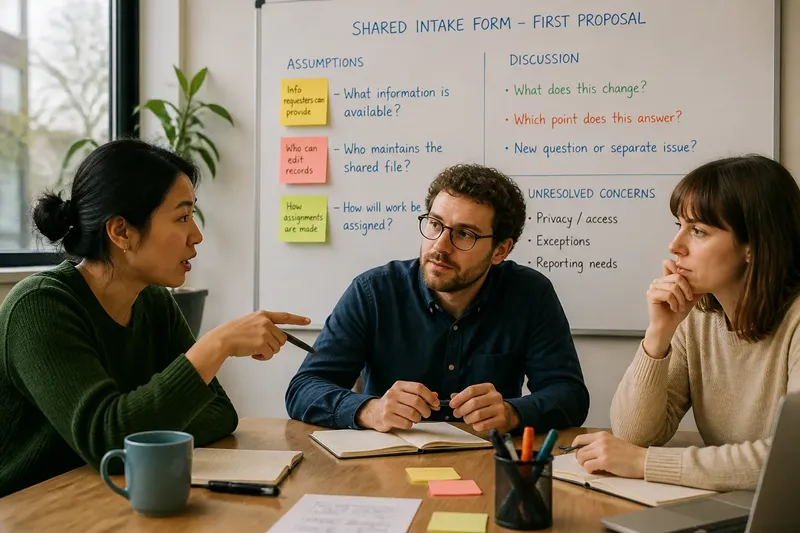
A project team has a whiteboard full of ideas, but each person is describing a different destination. One wants a faster handoff; another wants fewer exceptions; a third wants the customer to know who is responsible. Asking for a vote would produce a tidy mark beside one option. Asking what the group should carry forward can produce something more durable: a shared idea that keeps the useful parts of those views in sight.
The point of a good group question is not to make everyone agree. It is to help people contribute distinct knowledge and then make a decision that does not erase what they noticed. That requires more than wording. The question needs a clear object, a way to compare answers, and a place for the group to record what it has learned.
What should the group carry forward?
When a discussion has several plausible answers, separate the destination from the route. “Should we use a form or an email?” asks the group to choose a tool. “What information must stay attached to a request as it moves between people?” asks what the tool needs to preserve. The second question can reveal whether either option fits and give the eventual decision a usable standard.
This is not a trick for avoiding decisions. A group still needs to choose, assign responsibility, or accept a limit. But the decision becomes more intelligible when participants can see which shared need it serves. Record that need in plain language before the conversation moves on.
Try a short sentence that starts with “We need a way to…” or “The next decision should help us…” Avoid fitting every preference into it. The sentence is a working handle for the discussion, not a souvenir of unanimous agreement.
How can different views become useful material?
People often disagree because they are looking at different parts of the same process. A person who receives requests sees missing details; the person who handles them sees repeated entry; the person waiting for a response sees silence. Treat these as observations to connect, not positions to score.
Ask each participant to name the situation their view comes from and what they believe it implies. Then compare the answers: which concern is shared, which applies only in certain cases, and which would change the decision? This gives the group a way to preserve differences without pretending they all point in one direction.
A simple working record can help:
- Observation: What happened or what does this person regularly encounter?
- Interpretation: What does the observation suggest might be happening?
- Implication: If that interpretation is right, what should the group consider?
- Open point: What is still unknown or disputed?
Keep the categories separate. “Requests arrive without an owner” is an observation; “people do not care” is an interpretation, and an unhelpful one unless someone can explain its basis. The distinction makes it easier to use a perspective without treating it as the whole story.
How should the group compare competing ideas?
Compare ideas against the need the group has named, rather than against who proposed them or how polished they sound. Ask what each idea preserves, what it leaves out, and which conditions would make it workable. If two ideas solve different parts of the problem, the choice may be a combination, a sequence, or a clear boundary between cases.
Make the decision rule visible. A team might prioritize keeping requests traceable, reducing duplicate work, or handling unusual cases responsibly. The group should state which consideration matters most for this decision and why. Otherwise, participants may keep arguing while using different standards without realizing it.
Not every concern can be resolved in the room. Mark unresolved points as conditions or risks, and decide whether they need more information, a limited trial, or an explicit acceptance. That is more useful than smoothing them into a sentence that sounds agreed upon.
What questions help the group carry an idea forward?
How do we keep a shared idea from becoming vague?
Name the situation it addresses and the change it is meant to support. If a reader cannot tell what would look different afterward, tighten the wording before treating it as a direction.
What should we do when two perspectives conflict?
Ask what each perspective is based on and whether the difference depends on a particular person, stage, or type of request. Record the distinction, then decide whether it changes the choice or calls for a boundary around it.
How can a quieter participant contribute?
Give people a brief chance to write an observation before open discussion, then invite contributions without requiring anyone to defend a polished proposal. This makes room for specific knowledge that may be harder to enter through quick verbal debate.
When is the group ready to decide?
Decide when the group understands the need, can state the tradeoff, and knows what remains uncertain. If a missing fact could change the choice, assign someone to find it; if not, record the uncertainty and proceed within the agreed boundary.
How does this work in a concrete case?
Imagine an invented team handling requests that arrive by email and through a shared form. At the start, staff say that requests are hard to track, while the person managing the inbox favors making the form mandatory. The team writes down three observations: some email requests lack an owner, form submissions can also be incomplete, and unusual requests do not fit the form’s categories. These are hypothetical inputs, not claims about any real workplace.
The team then takes three actions. First, it separates the observations from the proposed fix. Second, it asks what information must remain visible until a request has an owner and a next step. Third, it compares the mandatory-form proposal with a revised option: keep the form for requests it can capture, while providing an explicit route for unusual cases and recording an owner for both routes.
The resulting decision is not “everyone agrees that the form is best.” It is to use the form where its fields fit, preserve an alternate route where they do not, and make ownership visible either way. The tradeoff is that the team must maintain two routes; the benefit it expects is clearer handling without forcing unlike requests into the same shape. The group can carry forward the shared need—traceable ownership—while leaving a concrete, inspectable choice in its place.
What is not worth the effort?
Do not keep rewriting the shared sentence until it sounds elegant enough to satisfy everyone. A plain sentence that names the need is more useful than a polished one that hides the tradeoff. Nor is it worth making a table for every minor preference; record differences that could alter the decision, not every shade of phrasing.
It is also a poor use of time to treat a quiet room as proof of agreement. Ask whether anyone sees a condition the proposed decision would miss, and give people a way to answer without turning the question into a ceremonial objection round.
How can the group keep the idea usable?
Record the shared need, the decision, its boundary, and any open condition together. When the group returns to the work, it can check whether the decision still serves the need rather than reopening every preference from the discussion.
The useful question to carry forward is not simply which idea won. It is what the group learned from the different views, what it chose to preserve, and what would prompt a different choice. That record gives the next conversation a starting point instead of another vote on the same whiteboard.